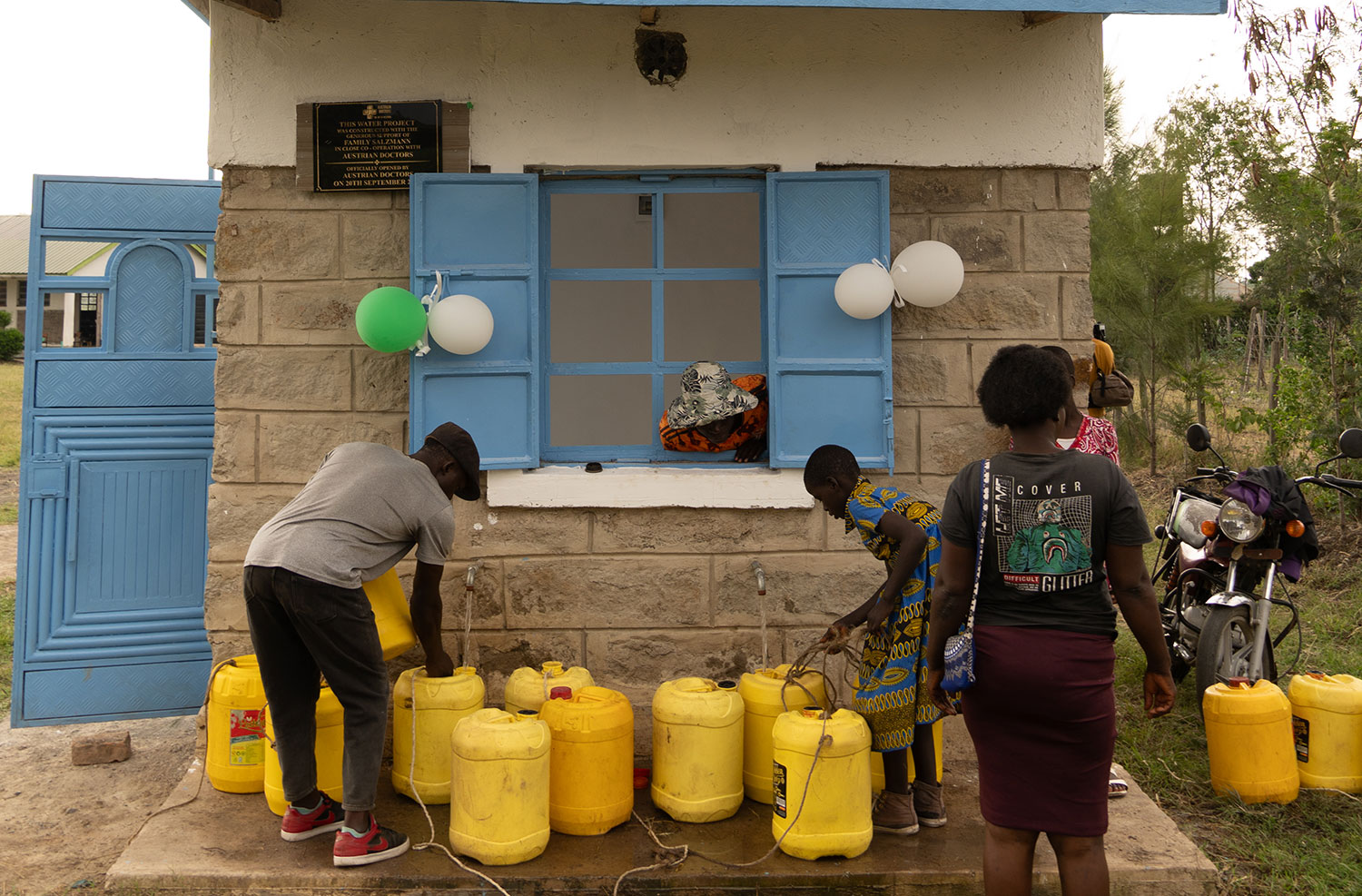
The topic of “clean, available drinking water” has many different aspects: first and foremost, it is a human right – which unfortunately is not a reality for over 2 billion people.
Secondly, it is a very important health issue, as a large number of diseases are transmitted through the consumption of and contact with contaminated water.
And it is an educational issue, as in the vast majority of countries in Africa, for example, it is traditionally the task of girls and women to fetch water for cooking and washing. As the water points are often very far away from the houses, millions and millions of girls spend so many hours a day doing this that there is no time left to go to school. The problems are exacerbated by climate change and associated events such as long periods of drought followed by heavy rainfall and flooding.
As you can see, there are many different facets to the topic of “water”.
At the Eroret Preparatory School in Kenya, which we support, hardly a drop of rain fell between 2019 and 2023. Both nature and the animals living there were severely affected by this period of drought. The fathers of our schoolchildren, the Maasai men, had to trek hundreds of kilometers with their herds of cattle to find water and enough food for their animals to survive. Nevertheless, many of them died cruelly.
In 2023, Austrian Doctors then built a solar-powered well on the grounds of the Eroret School, which now supplies the school and surrounding houses with water. The well made it possible to start an agricultural project there, which means that the school can now grow a large proportion of its own food. If there is a surplus, it can be sold on the market and thus further contribute to the financial independence of the project. In addition, the children can now be taught modern farming methods. Thanks to the well, we were also able to start a reforestation project.
In 2025, the construction of another solar-powered well began in Awasi, our second project location in Kenya. The general conditions are similar to those at the Eroret school. Clean water is therefore guaranteed for the entire project, as is sufficient water for the reforestation project. And there will be a water extraction point that will also give the other residents of Awasi access to this water. Completion of the well is planned for Q3 2025.
The following UN Sustainable Development Goals (SDGs) are being promoted with the help of this project:
The Eroret School is run by John Kintalel, a Maasai who was one of 13 siblings and the only one allowed to go to school. Together with his wife Esther and a strong team of teachers, he runs the school, an agricultural project and this reforestation project.
In Awasi, the local NGO “Mary Hill Selfhelp Group” is responsible for implementing the project. The Mary Hill Selfhelp Group was founded in 2017 by Rose Omina and other residents of Awasi with the aim of sustainably improving life in the community. Austrian Doctors has been a partner of the Mary Hill Selfhelp Group from the very beginning and worked with the group to build the Nursery School and the Community Center.