
Viktoria and Michalina with Austrian Doctors in Bangladesh
Arriving in Dhaka early in the morning, in the smog of the first rays of sunlight, had something truly special about it.


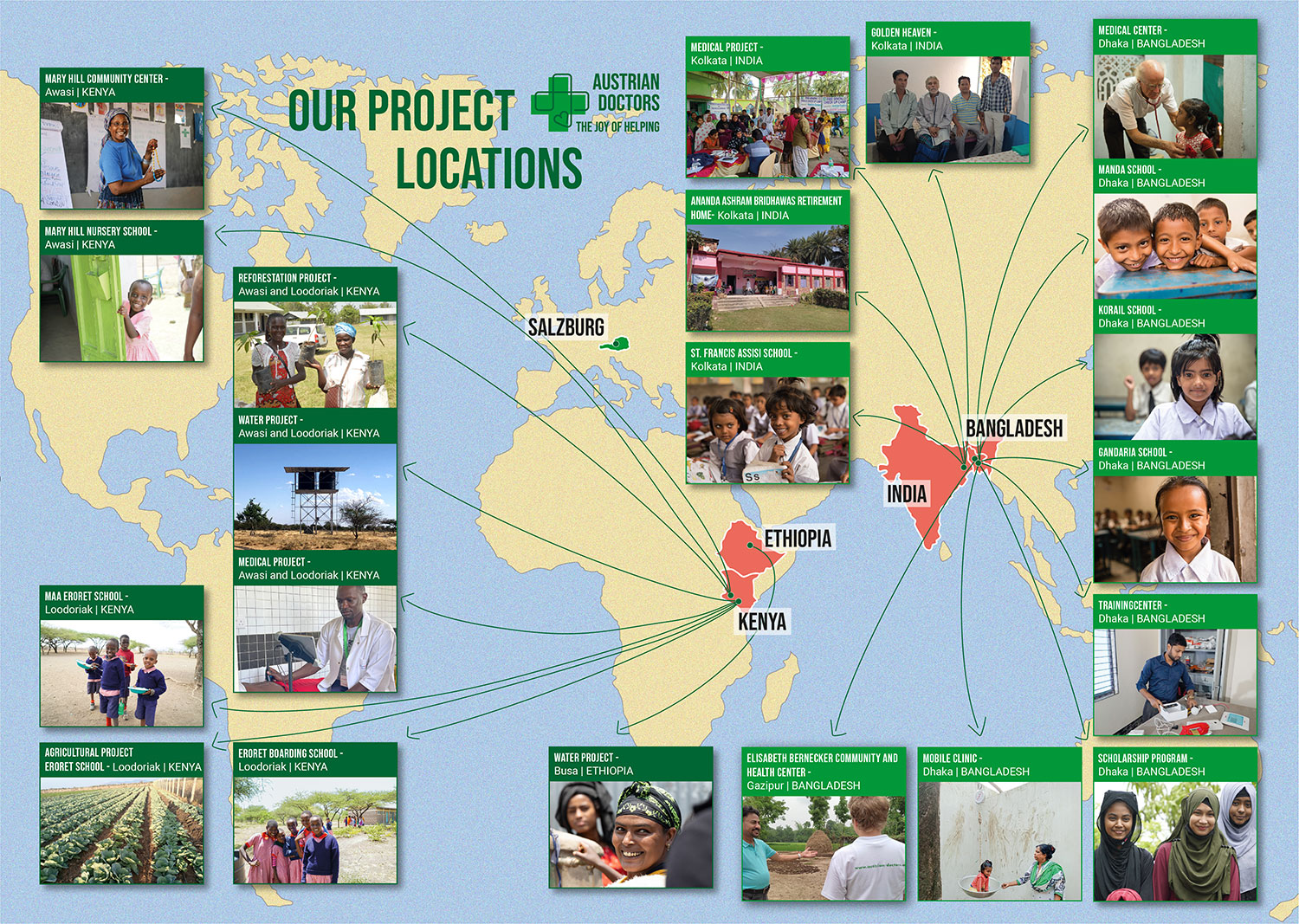
A lack of access to clean drinking water has an impact on health, education and the economic development of entire settlement areas. In cooperation with Menschen für Menschen, we are therefore building a drinking water supply system in the small town of Busa for the approximately 30,000 inhabitants.

The construction of solar-powered wells at our two locations in Kenya has made an important contribution to the independence of the projects. The clean water, which is now available all year round, not only benefits the people, but also enables the expansion of agricultural projects and reforestation programs.
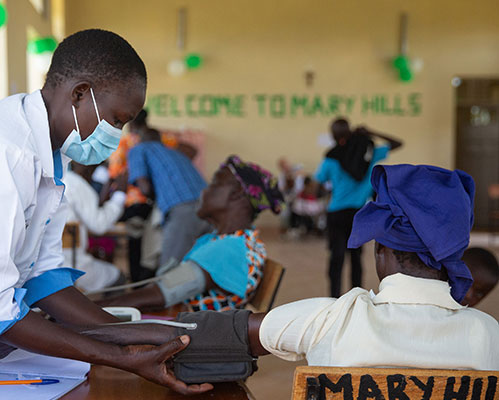
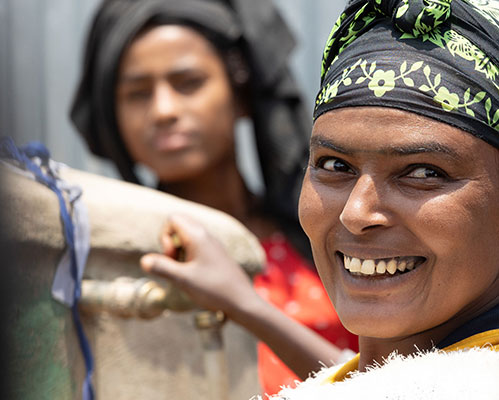
The lack of basic medical care is a major issue in Kenya. Some of the biggest challenges include HIV, malnutrition, malaria, and FGM – to name just a few. At both of our project sites in Kenya, we are therefore also actively engaged in providing medical support.

Thanks to a solar-powered well at Eroret School financed by Austrian Doctors, it is now possible to cultivate the school's own fields all year round. This means that the majority of the school's food can be grown on site and the pupils can receive practical training in modern farming methods.

The consequences of climate change, which we are already feeling strongly in Austria, are much more severe in countries like Kenya. To counteract the associated problems, the Austrian Doctors are launching a reforestation program in 2024.

The center offers workshops on family planning, sexual health, women's rights, climate change and much more. This enables the adult population to learn new methods in agriculture, for example, so that they can better provide for their families themselves.
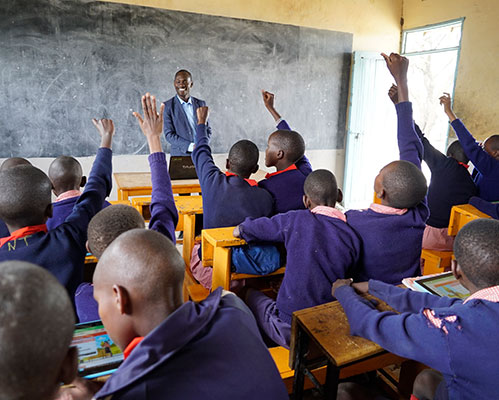
Austrian Doctors has been a partner of the MAA Eroret School in Loodoriak, Kenya, since 2017. MAA Eroret School is a school where about 300 children are taught. All pupils also receive a hot lunch every day and have the chance to improve their lives sustainably through education.

For many girls in rural regions of Kenya, attending school remains a daily challenge due to long and dangerous journeys to school. To change this, we have launched a new project: The construction of a boarding school for girls at the MAA Eroret School in Loodoriak, Kenya.

Over 80 children have the opportunity to attend the compulsory preschool here. They are allowed to play in a safe and carefree environment and are supervised by trained teachers. As a healthy diet is particularly important for young children, they are given a nutritious snack and lunch.

Our new medical project opened at our training center in Dhaka in February 2023. Two local doctors treat up to 300 patients per week. Thanks to the in-house pharmacy, patients can also get the medicine they need.

Many people in Dhaka are so poor that they cannot afford transport to our Medical Center. Since February 2024, we have therefore been taking our Mobile Clinic to where they live.

A school including a social and health center is being built in Gazipur. The center is currently under construction.

The training center aims to give young adults the chance of a better future. Here they have the opportunity to complete practical vocational training.

For many people, education is the best way to build a better future. This is why Austrian Doctors has been supporting schools in the underprivileged areas of Dhaka for over 30 years. The largest school is the Manda School with around 1,200 children.

Gandaria School was founded in 1992 and provides education for children from nursery (preschool) up to 8th grade. Approximately 300 students attend the school.
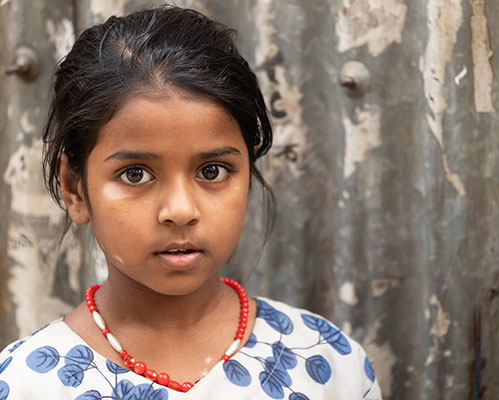
The Korail School was founded in the mid-1990s and offers educational programs from preschool up to 8th grade. Around 300 children currently attend the school, which is supported by a dedicated team of twelve staff members.

Some talented schoolkids continue to receive financial support after completing primary school so that they can attend secondary school and then go to university.

Together with its partner organization Kamina Social Welfare Society, Austrian Doctors runs a retirement home for 30 senior citizens in West Bengal. This enables them to spend their twilight years in dignity.

We provide medical care for those who no one else can help. In addition to general health checks, eye and dental check-ups are also offered in these camps.

Golden Heaven is a home for mentally and physically disabled people whose relatives cannot afford care. At the moment, 20 people live there, but there are plans to take in more.

At the end of the 1980s, the Prado brother had the dream of creating a school for the poorest children in the poor sister city of Kolkata, Howrah. Demand is still very high and more than 500 pupils attend the school.

A short description of the service and how the visitor will benefit from it.
A short description of the service and how the visitor will benefit from it.
A short description of the service and how the visitor will benefit from it.
A short description of the service and how the visitor will benefit from it.












Arriving in Dhaka early in the morning, in the smog of the first rays of sunlight, had something truly special about it.
